


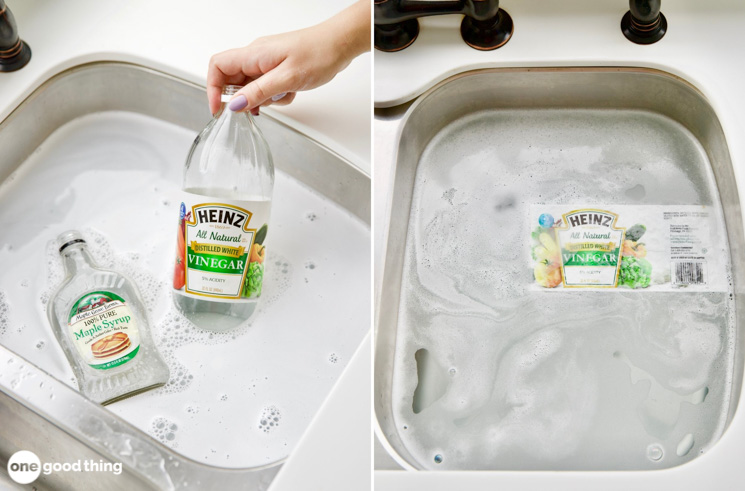
For the longest time I had a love/hate relationship with repurposing and reusing empty containers. While I loved being able to give empty bottles and jars new life by finding some other way to use them, I also hated how hard it was to remove those impossibly stubborn labels attached to them!
Over the past decade of my blogging career, I’m sure I’ve tried nearly every method under the sun for removing labels from glass jars and containers. I’ve mixed up dozens of potions and concoctions in my attempts to remove that sticky combination of paper and glue, but as is often the case, it turned out that the best solution was also the simplest one!
And I’ll be sharing my super simple method for how to remove labels from jars, bottles, and other glass containers here in today’s post. Hopefully this quick and easy method will make us all more likely to repurpose our glass instead of throwing it out! :-)

My Secret Weapon for Removing Labels From Glass
It turned out that the solution to my problem of how to easily remove labels was already in my laundry room cupboard: OxiClean! Just one scoop of OxiClean and some warm water is all you need remove the labels from a whole batch of jars, bottles, or other glass containers.
Not only is it among the most effective methods I’ve tried, but it’s by far the easiest one! The OxiClean does all of the hard work for you, and you just sit back and watch those stubborn and sticky labels slide right off!
To learn about other useful things you can do with OxiClean around the house, check out this post!
How to Remove Labels From Glass
You’ll need:
- Sink stopper
- Gloves
- OxiClean

Directions:
Start by gathering the glass items whose labels you want to remove. Place a sink stopper in your sink’s drain, add a scoop of OxiClean, then start filling your sink with warm water.

Turn off the water when the water level in the sink is high enough to cover your bottles. Place the glass into the Oxiclean solution, and allow it to soak there for about 30 minutes.

After half an hour, come back and check on the labels. (Put your gloves on first though—OxiClean can really dry out your skin!)

The labels may have fallen off the glass at this point, or you may only have to peel them off. Either way, you shouldn’t have any trouble washing away the remaining residue!


Then just give your glass items a quick rinse, dry them off, and they’ll be ready to reuse in whatever way you see fit! :-)
What About Other Types of Containers?
While this is by far the best method I’ve used for removing labels from glass containers, other methods may work better on other types of containers. Get all my best tips and tricks for removing labels and other types of stickers from all sorts of surfaces, check out this blog post.
More Ideas You'll Love

What sort of containers do you like to reuse or repurpose?




I used goop off this past year to get the labels off. We use the jars at Christmas and put tiny lights in them. It’s so pretty on our fireplace.
Please log in or create a free account to comment.The store I work at has a huge bin for glass recycling.
Unless the bottel is one that is lovely and that you wish to keep to display, why remove the label? If you are recycling the bottle, caps that can be attached and labels do not need to be removed.
Please log in or create a free account to comment.OOPS, meant to spell that “bottle.”
Please log in or create a free account to comment.If people are not reusing their glass bottles, I hope they are not “throwing them out” as you mentioned . I hope the bottles are put in a recycling bin. I will try this OxiClean soaking method the next time I want to remove labels from glass bottles. Since the soaked bottles had the tops off, I’d suggest they have a good wash and rinse with hot soapy water before you used them for food storage.
Please log in or create a free account to comment.I get an old dish towel and fold it longways into two or three thicknesses, depending on the height of the label and jar. I soak it through and only wring slightly and wrap it around the jar and secure with a few rubber bands. I keep it in the sink, wetting again as needed and then the labels will slide right off after awhile. Often I do have to use some oil with a plastic scrubber for a few seconds to remove the glue.
Please log in or create a free account to comment.i am definitely putting Oxi-Clean and WD40 on my shopping list though after reading the posts below. Thanks!
Jillee ❣️ ~ thank you so much for all the info you share- I use you as my GoTo for anything and everything!!
Please log in or create a free account to comment.Id like to suggest that you add a comment or two to your posts to let us know if your suggestions are safe to use with Septic Systems.
Thank you dearie❣️❣️
“Oxygen bleach” (Oxy Clean, Stain Solver, sodium percarbonate, sodium carbonate, soda ash) are very effective against organic compounds (plants, blood, molds, slime, etc.) whereas acids like vinegar, citric acid, phosphoric acid, etc. are effective against inorganic compounds such as lime, calcium, minerals.
Oxygen bleach needs hot water and 4-5 hours to fully complete the chemical reaction that turns the solution into plain water and a few harmless salts, so items must be soaked. This is not only great for dissolving any glue containing organic compounds to remove your labels, it is also a superb cleaner of anything organic.
Not to sound like a commercial (!) but it will super-clean the sink you are soaking your items in of all food and hidden gunk. It is safe for stainless steel, porcelain, enamel, glazed tile, grout, cement, plastic, house siding, stucco, decking, roofing, anything that can be kept wet for 4-5 hours. I buy a 50 lb bucket of stain solver brand every year (they usually have at least one sale) and use it inside and outside the house. The front of our house faces north and the roof, cement, and siding start to get algae in the wet weather, oxygen bleach kills and removes the algae, keeping my front walk and steps from being slimy and slippery. And it is safe for the environment since it is just oxygen, water, a few salts that can be rinsed off of plants, lawn, etc.
(Be careful of porous surfaces, the oxygen bleach won’t hurt them but they may discolor from being soaked and absorbing a lot of water.)
Can’t speak highly enough about cleaning most everything with this, leaving only the inorganic stains to be treated with some type of acid.
Please log in or create a free account to comment.Great information. How do you keep the siding on your hose wet for 4-5 hours for it to be effective?
Please log in or create a free account to comment.Do you know if this is safe to go down the drain if we have a septic system?
Please log in or create a free account to comment.I soak a paper towel or rag in vegetable oil, wrap it around the bottle or jar, wait a bit and the label and glue just slide off
Please log in or create a free account to comment.Another method for removing labels: Fill the container with hot water. Wait about 10 minutes then start peeling gently from a corner. This usually doesn’t leave glue residue, but if it does, just a short spurt of WD40 will help. Then wipe clean with paper towels.
Please log in or create a free account to comment.Needed this method this morning! After bouts with 3 other methods, including goo gone and peanut butter, the label was still basically there, sans top layer. Thanks for all you do to make easy to follow directions, great photos, and practical help.
Please log in or create a free account to comment.I’m trying it right now on pickle jars. Seems to be working.
Please log in or create a free account to comment.use wd 40. Tear off label as best you can and or soak off. apply wd 40 , use scratch pad and wash with hot water
Please log in or create a free account to comment.Hi Jrae, for me, wd 40 sometimes works, sometimes not and like you say, get out the scratch pad
Please log in or create a free account to comment.and using both, most of the time it still doesn’t work. I often end up throwing the jar away. I’m giving the OxyClean a try.
Use WD 40 works great. Tear label off as best you can. The spray with WD 40. Use scratch pad and rubs right off. Wash will with soap and water
Please log in or create a free account to comment.Oh durn!! I can just kick myself for throwing out empty jars yesterday ! OH well I will save some more and got some in fridge waiting to be emptied.
Please log in or create a free account to comment.I usually just add them to the sink when I’m washing my dishes. I’m allergic to detergents (ammonium laurel sulfate) and use latex gloves, so I’m able to use straight hot water. By the time get the rest washed, the liable is floating in the wash water.
Sometimes I heat the label up with my hair dryer, or a cotton ball soaked with rubbing alcohol. The latter is a safe to use in cleaning grimy fingerprints off book covers etc.
For the tougher adhesives, I’ll use a dab on peanut butter, if it’s sturdy item,
Please log in or create a free account to comment.Great idea! Just remember to wear nitrile or rubber gloves. Washing soda Is very hard on the hands!
Please log in or create a free account to comment.Great! So glad someone finally mentioned Washing Soda! Many years ago a good friend, who worked cleaning houses, told me about using washing soda for most anything, woodwork, cabinets, greasy/dirty things both indoors and out. Makes everything squeaky clean and leaves no suds. Its my go-to for cleaning. a Handful in a half bucket of hot water and you are ready for anything!
Please log in or create a free account to comment.I am going to do a project with the labels, not the jars, haha…. do the labels come off nicely and in one piece? I can re-purpose some of the jars as well, obviously ….
Please log in or create a free account to comment.Labels! The bane of my existence! I began making homemade wine… the first batch went into brand new never been labeled before bottles… I felt like a kid at bottling shop … oooooh the label assortment and the bottle shrink capsules… I went wild…as we began to drink the wine reality settled in… all those pretty labels had to come off…nearly 90 bottles of wine (Firm believer of go big or go home). Sooo after much experimenting … pour very hot water into bottle, let sit a few minutes, test an edge and if it still gives grief let sit a few more minutes and try again … if it doesn’t give up the fight it probably won’t and you need to proceed with the above arm and hammer washing soda method or worse case scrape off and bring out the goo gone. All label adhesives are not equal… wisdom has taught me to save the labels for the bottles I give away and I put a label on the wine box…cover it with another label when the box is emptied and reused…
Please log in or create a free account to comment.I just tried this. I experimented on a large pickle jar that had both a paper label, and one of those horrible plastic labels. They both came right off without any scrubbing or extra work!! I had NO residue to remove. Thank you for this amazing tip!! I had never heard of the washing soda prior to this post (I’m fairly new to the blog) so I am also excited to try all the uses for this as well! Thank you again!
Please log in or create a free account to comment.I like this. But I want to know about washing soda will it be ok in the sink? I hope
Please log in or create a free account to comment.The sink will not go bad. Do let me know about this.
Thank you.
Margret Mary.
You can always use a bucket or other large container, and you would also use less water. Hope this helps!
Please log in or create a free account to comment.I find the same result (label coming off) with just soaking in plain warm water. I don’t need to add anything to the water. I don’t use plastic, so don’t know if it works for plastic also.
Please log in or create a free account to comment.You are very lucky, then, Gail. I don’t know if we have different label glue in the UK, but some jars are a nightmare! I usually soak them in some washing-up water but will still have to use Label Remover to get everything off. I then wash them again. I don’t know if we have Washing Soda in the UK – I will investigate. (It’s probably called something else.)
Please log in or create a free account to comment.We do have washing soda in the UK Camilla, the big supermarket near me label their own brand as Soda Crystals. We use a couple of teaspoons in each wash instead Calgon and the like, as we live in a very hard water area. Works a treat :) I shall give it a go with the labels, as even when hot water gets some of them off (and definitely not all!), there’s the usual residue which is a pain.
I use just water too. For the labels that don’t come off this way I use WD-40 on the dry container, letting them rest for a few minutes or more. The label often just slides off as well. For the labels that neither of these methods work on, I scrape them off with a knife as best I can then use the WD-40 on the remainder and glue. If that fails, I try soaking. When none of the above work, rubbing alcohol may work but I can’t use rubbing alcohol so I can’t say for sure.
Please log in or create a free account to comment.For me labels on glass is easy, it is plastic I have TROUBLE with.
Please log in or create a free account to comment.Exactly Barbara! I have the same issue. Cute plastic containers but the glue is so hard to get off. The most success I’ve had is to let them soak in regular vinegar for a couple of days. Hope that helps.
Please log in or create a free account to comment.I give them a little warmth with a blow dryer most labels peel right off. works great on boxes you want to reuse to shop stuff too
Please log in or create a free account to comment.You can peel off as much of the label as you can. Spray with WD-40 and start working the sticky stuff off. Sometimes I have had to let it sit for a few minutes. When finished rice with soap and water…! On plastic containers you will need to be more gentle…or you’ll end up with scratch marks.
Please log in or create a free account to comment.Would this work for plastic bottles as well? I have a bunch of pill bottles I want to repurpose but need to get the labels off first.
Please log in or create a free account to comment.Stickers on pill bottles usually peel right off on their own.
Please log in or create a free account to comment.My pharmacy must use some sort of super sticky adhesive. The paper rubs right off but it still leaves a sticky residue on the bottles. Time to break out the peanut butter it seems.