


After writing this post about the advantages of rubber cutting boards, several eagle-eyed readers left comments and sent emails to inform me that I was holding my knife all wrong. Before that point, I honestly had no idea that there were right or wrong ways to hold a kitchen knife!
So with the help of my daughter Britta, I sought out the expert advice of our favorite professional chef, her husband (and my son-in-law) Neil. He had so many useful tips about knife safety to share with us that I knew I wanted to share them with all of you too, and that’s exactly what I’ll be doing in today’s post.
So I owe big “thank yous” to Neil for setting me straight, and to the readers who drew my attention to this topic. Today’s post wouldn’t exist without you, and now we’ll all benefit from knowing how to hold and use our knives safely!
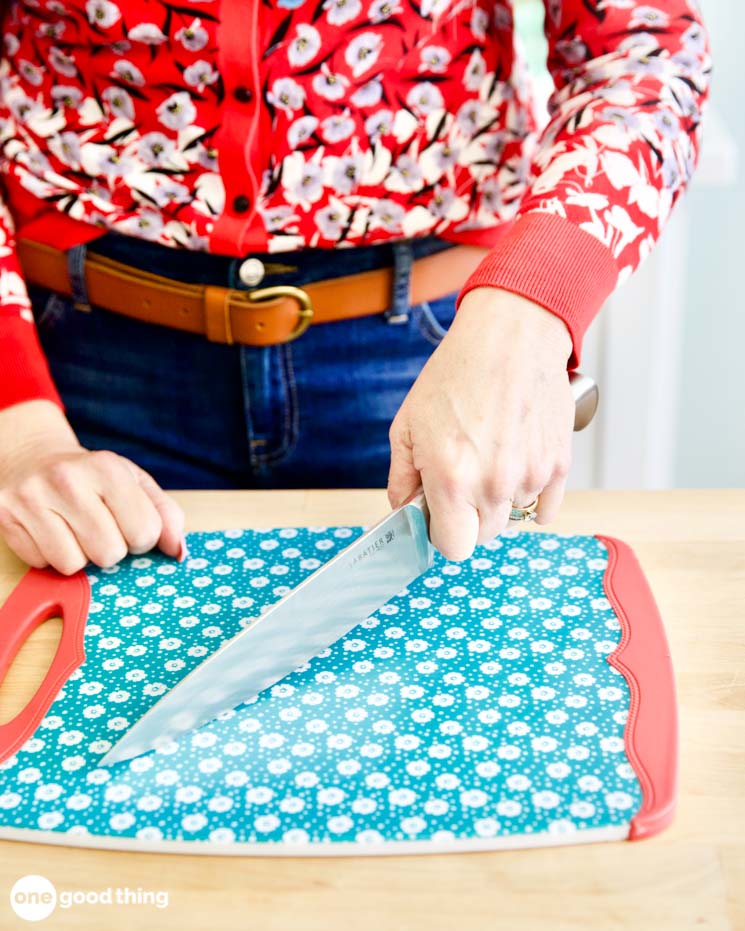
A Quick Review Of Knife Terms
I found out very quickly that it’s hard to understand how to hold a knife if you don’t know the names for the various parts of a knife. So before we jump in, let’s quickly review some basic knife vocabulary you’ll see used throughout this post:
- Blade – The front section of a knife that has a sharpened edge for cutting.
- Handle – The back section of a knife where it is meant to be held.
- Bolster – The area where the blade meets the handle.
- Spine – The unsharpened top edge of the blade.
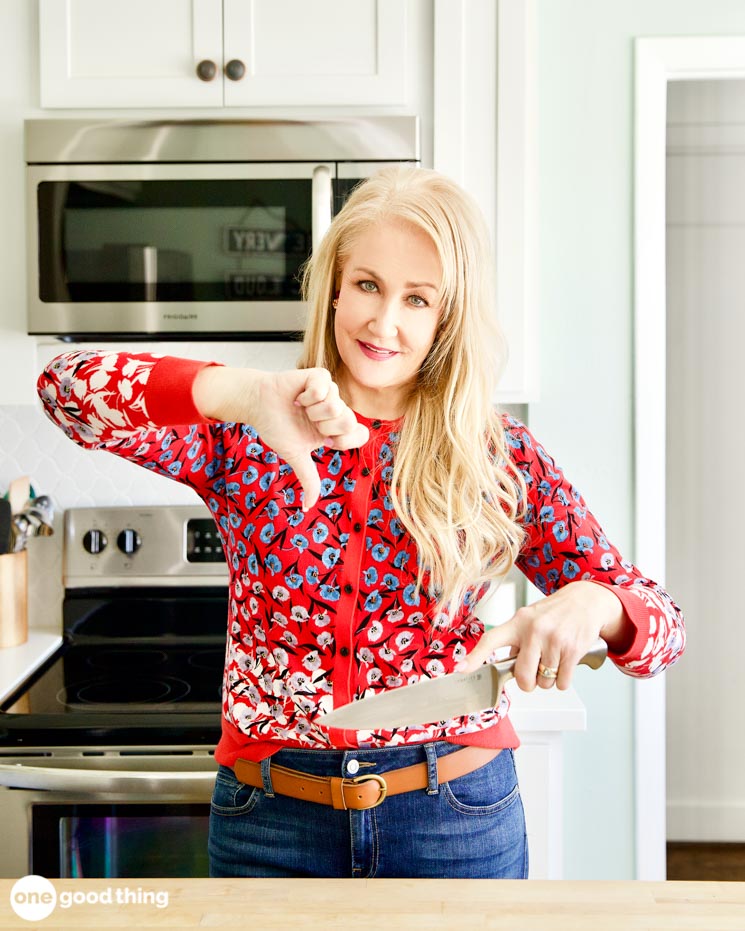
How NOT To Hold A Knife
The method I was previously using to hold a knife is called the “finger grip,” and according to Chef Neil, it’s a classic example of how not to hold a knife! With this grip, your index finger is positioned along the spine of the blade, and that’s exactly what makes it such a knife safety no-no.
While perching your index finger along the spine may give you a sense of control over the blade, the added pressure on the spine can cause your finger to slip, or tip your knife to one side or the other.
Slipping and tipping are not at all desirable when handling a sharp knife, so now I know to just say “no” to the finger grip! Instead, switch your grip to one of the safer methods outlined below. :-)
How To Hold A Knife – 2 Safe Grip Options

Option #1 – The Handle Grip
When using the handle grip, your entire hand grips the handle behind the bolster. This is a solid and comfortable grip, making it a good choice both for beginners and people with small hands.

The only real limitation of the handle grip is that it doesn’t allow very precise control for fine cutting and slicing. For more control, consider using the next grip type.

Option #2 – The Blade Grip (AKA The Pinch Grip)
The blade grip (also referred to as the “pinch grip”) is the preferred grip of many experienced cooks and chefs. When using this grip, your thumb and forefinger rest against the blade in front of the bolster, while the middle, ring, and pinky finger are wrapped around the handle.
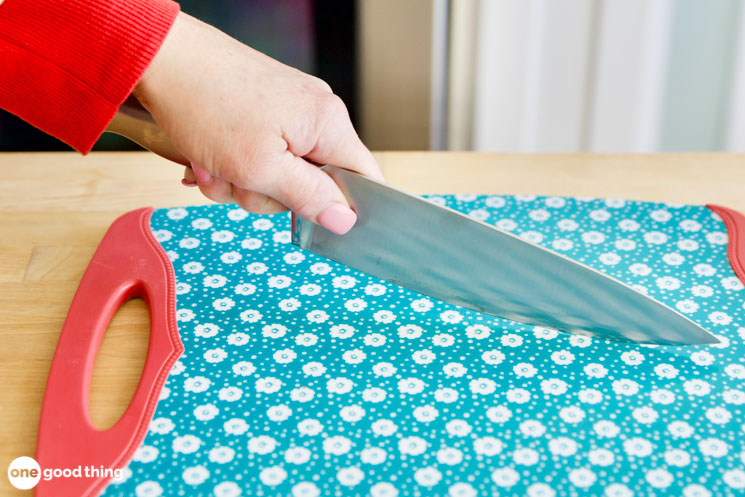
With the blade grip, your thumb and index finger are positioned at the balance point of the knife. This gives you more control over the tip of the blade, and because you don’t have to use as much force, it’s better for your knife in the long run.
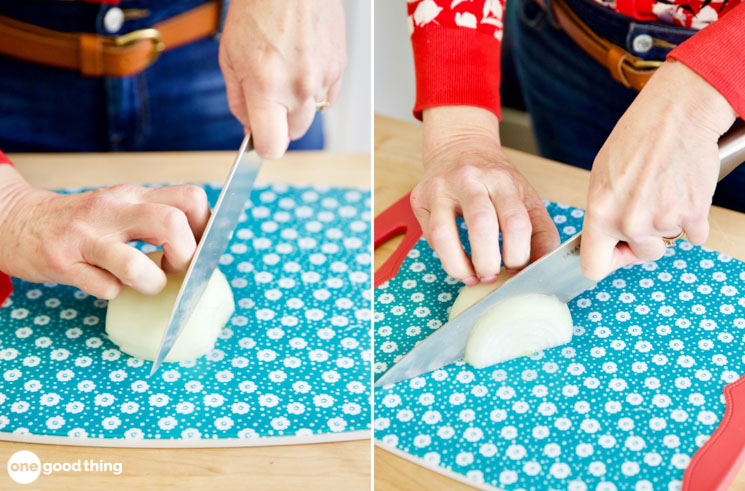
Bonus Tip – Use “The Claw” To Protect Your Fingers
Holding your knife safely is important, but it’s equally important to hold your food safely too. Holding your food safely helps keep your fingers out of harm’s reach while using your knife.
The best way to do this is by using a grip called “the claw.” Hold the food in place with your fingers curled, so that your finger tips are protected and the middle section of your fingers (AKA your “intermediate phalanges”) are perpendicular to the cutting board.
When using “the claw” to hold your food, the flat surface of the middle section of your fingers acts like a safety guard. You can’t really cut yourself unless you raise the blade above your knuckles, so just make sure to keep your knife close to the cutting board and your fingers curled.
More Ideas You'll Love


Which grip do you use to hold your kitchen knife?








Where is your floral cutting board from
Please log in or create a free account to comment.It is from the Pioneer Woman line. I bought mine at Walmart, but it looks like they are out of stock. You may want to try Amazon.
Please log in or create a free account to comment.I recently learned about the Pinch Grip while watching a PBS re-broadcast of a Julia Child program where she went into great detail about how to hold a knife. I have found it to be much easier for my chopping duties.
Please log in or create a free account to comment.I guess I mostly instinctually Gabe used the blade grip because I feel more in control. As to the claw, I’ve never been able to do it consistently because it feels so unnatural. So I went with just as good if not better: a cut resistant glove! My manicurist thanks me…
Please log in or create a free account to comment.*have* Really, I do proofread, but the trigger finger is faster than my brain!
Please log in or create a free account to comment.Thanks so so much I’ve learnt an important concept today.
Please log in or create a free account to comment.Great advice! You might consider doing a series on “knife cuts” ie, slicing, dicing, julienne, etc. or “knife styles” ie, what knife is best to use for what task. Thanks for keeping us all in the know, Jillee!
Please log in or create a free account to comment.When you have done all your practice knife cuts you can freeze the vegetables for later.
Please log in or create a free account to comment.Michelle
For extra safety, when carving a turkey, chicken or roast, wrap the handle of the knife with a paper towel. When the handle gets greasy, your hand won’t slip on the grip!
Please log in or create a free account to comment.I knew about the claw but you are right – I was using the index finger along the spine to make it steadier and I can why Option 2 would be better. Thank you so much. And pass my thanks on to Neil as well. We home cooks need all the help we can get from the pros.
Please log in or create a free account to comment.Stay well.
Yes Miriam… I guess that old saying, “You learn something new every day” is so true. I will let Neil know that you said, thank you!
Please log in or create a free account to comment.I’ve always used the handle grip and never gave much thought to other methods, possibly because I have very small hands (My favorite “chef’s” knife is only 8″ long). Mincing, julienning and making thin slices are the most challenging for me so maybe a pinch grip would help with these. I know I at least never mastered the technique of “rocking” the knife when cutting, although this may be a matter of countertop height.
Please log in or create a free account to comment.The knife tutorial is very useful – thinks! I’m going to try the pinch cut this evening.
I’ve cut my hands many many times over the years, sometimes badly, preparing food and only about two years ago I learned about wearing a kevlar glove on my food-holding hand. They’re inexpensive, interchangeable (no left or right), washable and sturdy and though they might feel a little clumsy, they’re great for protecting your hand that isn’t holding the knife from knife slip injuries. I use them when I’m cutting slippery or partially frozen food or other food that’s hard to cut (like hard cheese) or while sharpening knives or, especially, while using the dreaded knuckle-nibbling box grater. Very much worth buying and using.
Thanks as always for your terrific articles!
Please log in or create a free account to comment.Thanks for sharing this great tip, Carolyn!
Please log in or create a free account to comment.Thank you, I will definitely try both of these methods and find the easiest for me.
Please log in or create a free account to comment.I watched some other chefs a couple of months back and realized I, too, was holding my knife incorrectly. I hold the window scraper the same way when I clean snow from my car windows. I’ve been trying ever since I watched the chefs to hold it properly, but after 50 years of doing it wrong, it’s mighty hard to switch.
Please log in or create a free account to comment.I ADORE your red floral sweater/top! Would you mind sharing where it’s from or better yet, a link to it. If it’s not current, maybe just some info so I could try to find it. Thanks! And thank you for the knife info. Very helpful.
Please log in or create a free account to comment.I second this request! I love your sweater as well. I will also be implementing the suggestions made for knife use. Thank you so much,
Please log in or create a free account to comment.Thanks Elizabeth! I bought the sweater at Ann Taylor and it looks like they are offering 50% off! Here is the link:
Please log in or create a free account to comment.Poppy Ann Cartigan
Great post. I’ll pay more attention from now on. I love to chop – it’s like wac-a-mole with a purpose. Works out alot of frustration. Love your outfit and your cutting board.
Please log in or create a free account to comment.I love it!! :-)
Please log in or create a free account to comment.Hi Jillee,
Thank you for taking note of comments about your previous knife grip, I was one that sent an observational response in the interests of your safety and that of your readers.
As a retired chef/lecturer I would always advocate using the pinch grip as the knife is then an extention of your hand which gives greater accuracy and manouverability. The claw grip is the safest way to hold items, also, stance is important, straight infront of your chopping board with feet about a foot appart, this prevents any wobbles in balance (particularly important when getting older or have health issues ).
The last thing and most important is to, KEEP YOUR KNIFE SHARP, either by the simplest leather strop and compound, a chef’s steel or if you really have no other option then a branded sharpener.
Enjoy cooking and please keep it safe.
222
Please log in or create a free account to comment.I’m probably the only one who shouldn’t use a sharp knife! A couple years back I got a few Cutco knives which are super sharp. I had heard that sharp knives were better but I have never cut myself so much in my whole life than I have since using those sharp knives. All it takes is to barely touch yourself with those sharp blades and you have a cut. I actually have some cut proof gloves that I wear when I think I may ct myself. :)
Please log in or create a free account to comment.Honestly Leslie, when using a blunt knife you have to exert much more pressure when cutting food items, if your knife were to slip onto your fingers the results would be torn skin, this can be worse than a cut from a sharp knife and heals slower.
Wear your glove and try to persevere with the sharp knoves; you could do some cutting drills (different cut shapes) on veggies, to practice, then make a casserole or freeze everything for later use
Take care,
Michelle
Michelle, thank you so much for these great additional tips!
Please log in or create a free account to comment.