


Have you wandered through the egg aisle at your local grocery store recently? Talk about information overload! There are so many different labels, certifications, and varieties of eggs that it’s very easy to feel overwhelmed by it all. But all of that is going to change today!
I want to help unravel the mystery of all those different kinds of eggs, so our trips through the egg section are filled with certainty rather than doubt. :-)
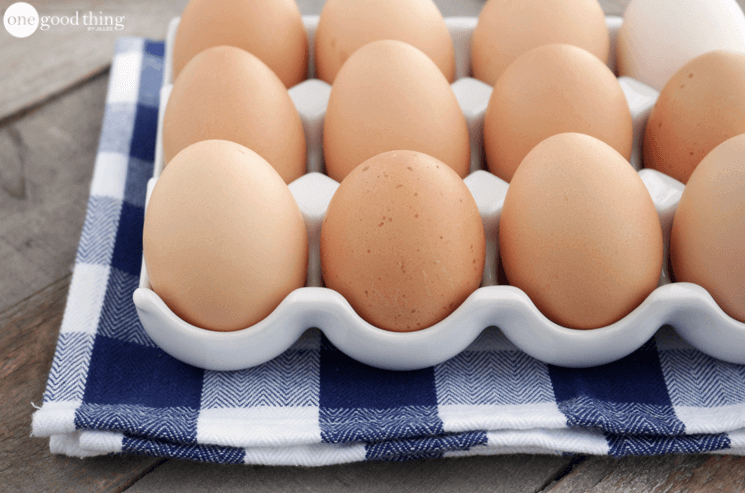
So buckle up, because today’s post is all about eggs! Or is it all about chickens? Regardless of which came first, we’re talking about eggs and the chickens who lay them. :-)
There are two common types of distinctions made on egg carton labels, and we’ll be talking about both! The first is housing types, or the kinds of conditions that the hens live in, and second I’ll cover diet types, or the kind of food that the hens are fed. I’ll talk about each one, and what difference each distinction makes (or doesn’t make) in terms of the price and quality of the eggs. So let’s get started, shall we?
Housing Distinctions

Conventional
The eggs produced by chickens in conventional housing are usually the most budget-friendly. You can find them for about $2.50 to $3.50 per dozen at most grocery stores. Chickens in conventional housing are kept in “battery” cages at all times, with 24/7 access to food and water.
With these kinds of cages, farmers can keep more egg-producing chickens in a smaller space, and then sell those eggs for a low consumer-friendly price.

Cage-Free
Many stores and restaurants have recently turned to “cage-free” eggs. “Cage-free” eggs aren’t inherently different from conventional eggs, the chickens are just housed differently. In a cage-free facility, the hens are allowed to roam around instead of being kept in a small cage all the time.
It’s not clear whether cage-free facilities are more humane than conventional ones. Some egg producers will even argue that the birds have a better quality of life in cages, citing a smaller chance of the birds hurting themselves or each other. Ethical aspects aside, cage-free chickens are still crowded in their laying houses. And because the farmers aren’t using space as efficiently, their costs are higher, and that premium gets passed onto the consumer.

Free-Range
Free-range eggs have much of the same requirements of cage-free eggs, with the added requirement that the chickens have “access to the outside.” The chickens have an outdoor area they have access to, but it is usually just a small patch of yard.
Many chickens choose to simply stay inside, even when they have access to a “free-range” yard. Otherwise, the diet for free-range chickens is quite similar to cage-free birds, and most birds still only have have 2 square feet of space to themselves.

Pastured or Pasture-Raised Eggs
Pastured eggs are one of the best options available in stores, but they’re also one of the most expensive egg options. For the most part, these hens are kept in mobile coops at night to roost and lay eggs. But during the day, farmers release the chickens into pastures where they are can forage, take dust baths, soak up the sun, and just be chickens.
While the nutritional content of eggs is pretty much identical across all housing varieties, there is some evidence that eggs from pastured chickens are an exception. Some sources suggest that pastured eggs have more vitamins and less cholesterol due to the chickens’ increased access to sunlight and a highly varied diet.
Diet Distinctions

Organic
Farmers provide these hens with feed which is certified organic. If eating organic is important to you, organic-fed eggs could be a good option for you. But keep in mind that there are fewer certified organic feeds than standard feeds, so the chickens may end up with a more limited diet overall. And of course, organic eggs are definitely more expensive than conventional ones!

Omega-3
The hens that produce Omega-3 eggs are fed a diet with plenty of Omegas, such as kelp, flax, and linseed. This makes for a more nutritionally beneficial egg, offsetting fats in the eggs that are not as healthy.
More Ideas You'll Love

According to Healthline, Omega-3 eggs had 39% less of the inflammatory omega-6 fatty acid and 5 times as much omega-3 as conventional eggs.

Vegetarian-Fed
Some egg-laying hens are fed a vegetarian diet. But did you know that chickens aren’t actually herbivores? They’re omnivores, just like us! (Fun fact: the modern chicken is the closest living relative to the great Tyrannosaurus Rex!)
Chickens love to eat insects, worms, even small mammals if given the chance. Vegetarian-fed eggs come from chickens that aren’t getting their usual sources of protein, and may even be protein-deficient.
In Conclusion
When it comes to buying eggs, there are a lot of buzzwords and designations that can make it a confusing choice! Hopefully the information above will help you make that decision with confidence the next time you’re at the store.
To find the very best quality eggs from happy hens, seek out local farmers and/or CSAs! If you call around enough, you’re sure to get in touch with someone who has a chicken coop, or knows someone who does. Because happy birds lay the most delicious eggs, in my opinion. :-)
Related: 11 Surprising Ingredients That Will Make Your Eggs Taste Better





I buy eggs that claim to be from free-range chickens although they cost more than $6 a dozen at the supermarket. I believe they really are free-range because they have deep yellow yolks. A lot of “cage free” eggs have the almost white yolks of conventional eggs. I learned how much more delicious eggs with bright yellow yolks are when my daughter raised chickens. Even though she lived in the city and her chickens lived in a fenced in coop they had enough freedom to lay the most amazingly tasty eggs. The fence was about 20′ x 12′ with a raised wooden coop they could hide under when it rained and sleep in at night. That tells me how very little freedom the white yolked “cage free” chickens must actually have.
Please log in or create a free account to comment.Hi Jillee, A friend and I bought eggs from the local farmer that are cage free. I checked with a “wholistic healer” who said if the eggs are not cleaned of feces but allowed to sit on the eggs the bacteria penetrates the shell. This being true the goodness of local farmers and their cleanliness or timeliness regarding “clean eggs” affects the efficacy of the eggs. We only buy organic and if any feces is spotted they are put back.
Please log in or create a free account to comment.http://ijr.com/2016/01/521121-eggs-cartons-freshness/
Please log in or create a free account to comment.As an Agriculture Educator, I think you did a wonderful job explaining the differences between the labels as upfront as possible. Public perception drives marketing and animal agriculture can easily become an emotionally charged conversation.
Please log in or create a free account to comment.Thank you!
Please log in or create a free account to comment.I used to live int he country and had about a dozen hens and one rooster. They had a coop to stay in at night and also a fenced in area surrounding the coop. First thing in the morning they were allowed out of the coop & fenced in area and were free to roam over my 5 acre plot of land (although they stuck pretty close to home in one acre). They were delightful pets to me, with their cooing and clucking. Some even sat on my shoulder occasionally! The point is, they ate bugs and scraps and had chicken feed and, in the winter, cracked corn to keep them warmer. The eggs my ladies produced were the most yellow and delicious I have ever tasted! Now that I live in town, it is difficult to find another backyard chicken setup but I have recently. I agreed (my idea) to pay the lady $6 per dozen because they are worth every penny!
Please log in or create a free account to comment.If I could make one comment – I have in the last few years become soy intolerant and unfortunately soy is in 65% of our food products! With regard to chickens and eggs, most commercial feed is soy because currently it is the cheapest oil and byproduct on the market. As a result if you are soy intolerant you will need to source a local farm to buy eggs that are not feed soy or a soy derivative.
P.S. Soy (lecithin) is in crackers, mayonnaise, eggs, meat, bottled asian and Indian sauces, and most commercially prepared products.
Please log in or create a free account to comment.Thank you so much for stating that chickens are NOT vegetarians! I avoid ‘veg fed’ eggs at all costs, as the egg shells are thinner & the yolks are pale. Chickens need protein…and given a chance…they will snarf a mouse in a heartbeat!
Please log in or create a free account to comment.Good to know. Thanks
Please log in or create a free account to comment.Jillee,
I found a website that rates organic eggs across the country. You are so correct in saying that descriptions can be confusing. Some companies will stretch the truth to the outer limits. Website is https://www.cornucopia.org/scorecard/eggs/
Please log in or create a free account to comment.If I want eggs, I just go to the pen in the backyard and look in the nests. I love keeping backyard chickens, and the best is knowing exactly what is going into my eggs, and how my birds are treated. Chickens are definitely omnivores-my hen caught a snake the other day. Great article Jillee!!
Please log in or create a free account to comment.I so agree! I just finished eating a couple of fried eggs fresh from the nest. Nothing like fresh eggs. Jillee, you should do a story on the freshness of store bought eggs. You will be shocked as to how old some eggs in the market are. Not to say they aren’t still good and healthy for you but when you eat an egg laid just hours ago you won’t want to eat another market bought egg ever!
Please log in or create a free account to comment.Miss Jillee, if you lived closer I would bring you dozens of my organic, cage free eggs. Our hens have plenty of place to roam in their enclosed predator-free runs.
Please log in or create a free account to comment.Certified organic eggs are the only eggs I buy at the store if I can’t get to the Amish for the weekend
Please log in or create a free account to comment.That was very informative. I kind of already know what cage free eggs are.Id worry about the chickens picking up illnesses from the other birds.We basically just get the regular eggs at our. If money wasn’t an important factor I might try some of the organic type stuff. Unfortunately this type of diet is expensive.
Please log in or create a free account to comment.This was surprisingly educational! I really didn’t know all of the details. I generally just buy what I have a coupon for LOL. Thanks for sharing!
Please log in or create a free account to comment.Having seen the conditions that the chickens in intensive egg-production facilities live in, I feel blessed that I live somewhere where I can buy fresh, locally produced and truly free-range eggs for £2.00 for a dozen, especially since I am on a very, very tight budget. I’d even pay a bit more, but my friendly egg-supplier only wants enough money for his eggs to keep ‘his girls’ in good chicken feed!
Please log in or create a free account to comment.I’d keep chickens myself, except that my husband is violently allergic to their feathers and ‘dander’ and wouldn’t be able to care for them if I was unable to do so. As Anne Connell observes, the yolks of these eggs are a rich golden colour and they just taste so much better than supermarket shop-bought eggs. Plus I know that ‘the girls’ are well cared for and have happy lives!
Maybe try ducks? Duck eggs are even more nutritious than chicken eggs! We love our ducks. So easy to care for.
Please log in or create a free account to comment.Lisa
Fresh Eggs Daily
I was horrified by a report I saw years ago about how hens suffer in those tiny cages on factory farms. Their feet become deformed from living on wire “floors” – claimed to be hygienic because excrement drops through. The birds were so stressed by being confined to this little cage that they pulled out their own feathers. I was so appalled that I never bought another factory farm/battery egg. These farms were banned in Switzerland years ago, thank goodness! I pay a bit more now for free range eggs. I live in the country and it’s good to see the chickens strutting around outside, digging for worms, dust bathing, or snoozing in the shade. Happy birds just make me feel better!
Please log in or create a free account to comment.I only buy eggs from chickens that were fed a vegetarian diet. Years ago, I watched an expose’ on egg farms that said that some chickens were fed the ground up carcasses of chickens who had died and that this practice was common on factory farms. I would love to be able to pay 69 cents for a dozen eggs at Aldi, but the carton doesn’t specify the type of diet that the chickens were fed and I am still too grossed out by that expose’ after all of these years.
Please log in or create a free account to comment.It would worry me more that these poor birds aren’t getting the diet they need!
Please log in or create a free account to comment.I agree Bea. I too only buy free range/pasture raised eggs. Yes I pay a premium but paying for eggs from chickens kept in horrible conditions does not sit well with my conscious and only supports the horrible practice. I have signed many petitions trying to change this in the USA. I realized too when eating out that I am probably supporting this so now I rarely get eggs out or go to places here who use local pasture raised eggs. Don’t mean to offend anyone…just my personal feelings.
Vegetarian diet usually means they are fed GMO soy products.
Please log in or create a free account to comment.Chickens need animal products in their diet, even if its just bugs, worms, etc. Your best bet is to find a local farm that sells eggs. Check Craigs List, look for signs along the road, or find a farmers market. Bottom line, NO commercial eggs can hold a candle to farm fresh eggs.
Please log in or create a free account to comment.With the number of eggs my growing family consumes I’d probably be better off investing in some hens but that’s not going to happen anytime soon although it is a growing trend in urban and suburban Ireland.
Please log in or create a free account to comment.The taste difference alone is why I opt to pay 60cent more per half dozen for local free range corn-fed eggs. The yolks are always bright yellow and almost curdy. I don’t know if buttered eggs are a thing on your side of the Atlantic but if available I’d highly recommend them. The farmer seals the fresh warm egg with a very thin layer of butter, it barely adds a sheen to the shells but it helps preserve their freshness brilliantly!
Poached eggs for brekkie now, methinks!!
Yes! You need your own chickens! They are so fun and easy, and you’ll never get fresher or more delicious eggs!
Please log in or create a free account to comment.Lisa
Fresh Eggs Daily