


Learning how to clean your dishwasher with vinegar and baking soda can help you keep this important appliance in good working order, and it’s easy to do! This process can also fix and prevent common issues affecting grimy dishwashers, including unpleasant odors, drainage problems, and poor performance.

What you’ll find in this post is a simple and highly effective method for cleaning a dishwasher. After walking you through it step by step, I’ll also share some tips to help you tackle stubborn buildup and odors and keep your dishwasher in good working order.
Ready to learn how to clean the inside of your dishwasher? Let’s get started!
Table of Contents


Jillee’s Take:
Decades of personal experience and years of blogging on the topic have taught me a lot about and dishwashers. I’ve poured all of my expertise and know-how into this dishwasher cleaning guide to help you keep your dishwasher in good working order and your dishes sparkling clean!
What’s the Best Way to Clean a Dishwasher?
The simple dishwasher cleaning method I’m sharing in this post uses two of my favorite inexpensive cleaning ingredients: distilled white vinegar and baking soda. Vinegar helps break down grime, dissolve mineral deposits and water spots, and kill bacteria while baking soda eliminates odors and scrubs away food residues and stains.
Author’s Note: If you accidentally put dish soap in your dishwasher, vinegar can help you clean up the mess!

Why do I recommend vinegar and baking soda for dishwasher cleaning? They’re cheap, easy to find, and effective! (Some folks recommend using Tang drink mix for its citric acid content, but vinegar is cheaper and carries no risk of bright orange stains!)
Vinegar and baking soda also play roles in my homemade dishwasher detergent, along with washing soda, borax, and salt. I also have a recipe for homemade dishwasher soap (not detergent) featuring vinegar, Dawn, and oxygen bleach that can help keep your dishwasher clean and makes a good substitute for your usual detergent in a pinch!
How to Clean Your Dishwasher in 3 Easy Steps
Start by feeling around the drain and removing any foreign material, then place a bowl of white vinegar on the top rack and run a wash cycle on the hottest setting. Next, sprinkle a cup of baking soda into the bottom of your dishwasher and run another hot wash cycle.
For (much) more detail, see the step-by-step guide below.
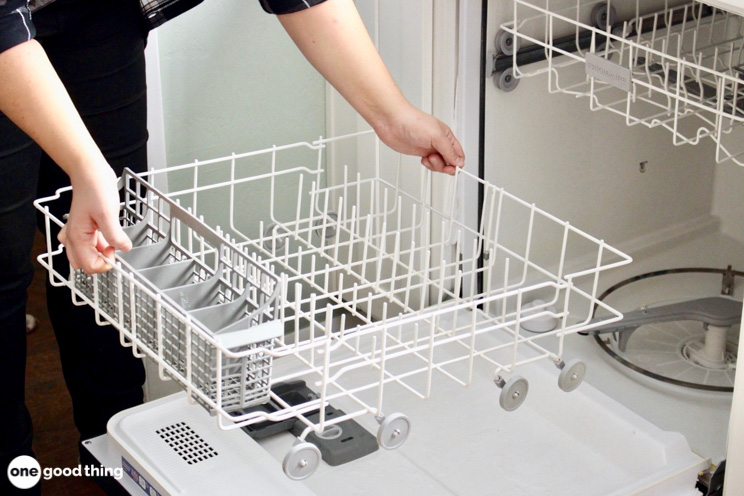
Step 1 – Check the Drain
Start by removing the bottom rack and inspecting the bottom of your dishwasher, especially the area around the drain. All sorts of things can collect down there, like bones, bits of plastic, broken glass, and other things that shouldn’t be in your dishwasher.

Step 2 – Vinegar Wash Cycle
Replace the bottom rack, place a shallow, dishwasher-safe bowl near the center of the top rack, and then pour 1 cup of white vinegar into the bowl. (You could use apple cider vinegar in a pinch, but there’s some risk of discoloration or staining the machine’s interior surfaces.)
Close the dishwasher door and start a wash cycle on your dishwasher’s hottest setting.

Step 3 – Baking Soda Wash Cycle
When the vinegar wash cycle is complete, remove the bowl and sprinkle 1 cup of baking soda into the bottom of your dishwasher. Start another hot wash cycle, and while that’s happening, wipe down the front of the dishwasher door with a damp microfiber cloth.
More Ideas You'll Love

Most dishwashers will be clean and fresh after Step 3, but tough stains and grime may make a third wash cycle necessary (see Optional Step below).

Optional Step – Bleach Wash Cycle
If your dishwasher isn’t quite as clean as you’d hoped after the baking soda wash cycle, performing a wash cycle with bleach can help. It’s particularly helpful when dealing with mold, mildew, and other tough messes.
To do it, pour 1 cup of chlorine bleach into the bottom of the dishwasher and run another hot wash cycle.
Warning: Skip this step if your dishwasher has a stainless steel interior — bleach may discolor or permanently damage stainless steel finishes.

More Tips for Deep Cleaning Your Dishwasher
If you followed all the steps above and your dishwasher still has an unpleasant odor or isn’t performing as well as you expect, try these deep cleaning tips.
Clean the Door Gasket
Persistent dishwasher odors can be caused by food particles or mildew lurking in the rubber gasket around the dishwasher door. Clean the gasket with a damp microfiber cloth, making sure to get into the folds where gunk often hides.
To prevent gasket odors in the future, leave your dishwasher door ajar after unloading clean dishes to let it dry out between uses.

Clean the Sprayer Arms
If your dishwasher is clean, odor-free, and draining correctly, but your dishes aren’t coming out sparkling clean, it may be a sign that the sprayer arms need cleaning. The holes in the sprayer arms can get clogged up by food residue and limescale, hindering your dishwasher’s performance.
To clean the sprayer arms, start by shutting off the water supply and power to your dishwasher. Remove the bottom rack from the dishwasher, then carefully remove the sprayer arms and scrub them thoroughly with warm, soapy water. (An old toothbrush or small scrub brush can help here.)
Pay special attention to the holes in the sprayer arms, and use an unfolded paper clip if needed to dislodge any blockages. When the arms are clean and dry, replace them in your dishwasher.
More Ideas You'll Love

Remove and Clean the Filter
If you’re removing your dishwasher’s sprayer arms to clean them, you should take the opportunity to clean the filter too. (In many dishwasher models, you can’t remove the filter without first removing the bottom sprayer arm.)
Refer to your dishwasher’s user manual for specific instructions on how to remove the filter, then clean it in warm, soapy water before drying it and replacing it. Don’t forget to replace the sprayer arms and bottom rack and restore the water and power supply.

How Often Should You Clean Your Dishwasher?
| Frequency | Task |
|---|---|
| Weekly | Wipe down the door and gasket and make sure the drain is clear of debris |
| Monthly | Perform the 3-step dishwasher cleaning method with baking soda and vinegar |
| As needed | Clean the sprayer arms and filter |

7 More Dishwasher Tips and Tricks
- Run your garbage disposal before starting a load of dishes to ensure it can drain properly.
- Start with hot water by running your kitchen faucet until the water feels hot to the touch before starting your dishwasher to get the most out of your wash cycle.
- Set your water heater to 120°F (50°C) to ensure the water is hot enough for cleaning dishes without being dangerously hot.
- Don’t overfill your dishwasher. Waiting to start your dishwasher until you have a full load is a good way to save water and energy, but packing it full of dishes can hinder its ability to clean them.
- Lightly rinse dishes before putting them in your dishwasher. Dishwasher detergents work best when there’s a certain amount of food residue on your dishes.
- Put caps on rusty tines. If rusty tines are leaving stains on your dishes, a set of cheap dishwasher tine caps offers a quick fix.
- Put a dish of vinegar in the top rack to help combat the effects of hard water, like water spots, white films, and dusty mineral residue.
Frequently Asked Questions
How Often Should I Clean My Dishwasher?
It’s a good idea to clean your dishwasher around once a month to keep it running smoothly. Regular maintenance can help prevent odors and grime buildup.
What Do I Need to Clean My Dishwasher?
Apart from white vinegar and baking soda, you only need a small bowl and a microfiber cloth for the 3-step dishwasher cleaning method. For deep cleaning tasks, you may need bleach, dish soap, an old toothbrush, or a few other basic cleaning supplies.
Can I Use Regular Dish Soap to Clean My Dishwasher?
I don’t recommend it! Dish soap is too sudsy to use in a dishwasher, so stick to vinegar and baking soda for a no-mess clean. (There’s more to know about using dish soap in the dishwasher, but that’s not the purpose of this post or question!)
How Do I Clean the Filter in My Dishwasher?
Specifics will vary by model (see your dishwasher’s user manual for direction), but most dishwasher filters are fairly easy to clean. Remove it from the bottom of your dishwasher, wash it in warm, soapy water, then dry and replace it.
What’s the Best Way to Deep Clean My Dishwasher?
The 3-step cleaning method described in this post does a great job of deep cleaning most dishwashers. Depending on how dirty your dishwasher is, you may need to follow the additional tips (i.e. cleaning the door gasket and sprayer arms) to get it truly clean.
Can I Combine the Vinegar and Baking Soda Wash Cycles into One Step?
I don’t recommend it. You’ll get better results by using vinegar and baking soda separately when cleaning your dishwasher. (This is almost always the case when using vinegar and baking soda for cleaning.)
Conclusion
Given its crucial role in kitchen cleanliness (not to mention that you can use your dishwasher for more than washing dishes), it’s in your best interest to keep your dishwasher clean and in good working order. The tips and methods in this post will help make the process quick and easy!
For those without a dishwasher or who often wash dishes by hand, don’t miss my dishwashing hacks for tips that will save you time and effort.
What’s your best tip for cleaning a dishwasher?

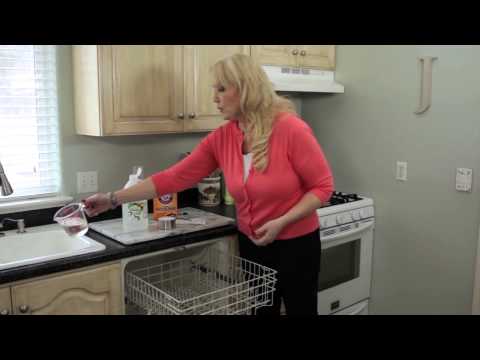
How To Clean A Dishwasher
Video
Equipment
- Dishwasher-safe cup
- Measuring Cups
Ingredients
- 1 cup distilled white vinegar
- 1 cup baking soda
- 1 cup bleach optional
Instructions
Examine the Drain
- Pull the bottom rack out, examine the drain area, and remove the foreign material you find (if any).


Vinegar Wash
- Place a dishwasher-safe cup of white vinegar on the bottom rack of your dishwasher, then run your dishwasher on a hot water cycle.

Baking Soda Wash
- After the first wash cycle, sprinkle a cup of baking soda around the bottom of the dishwasher and run it through another hot water wash cycle.


Bleach Wash (Optional)
- To eliminate mold and mildew, add ½-1 cup bleach to the bottom of the dishwasher and run another full wash cycle. (Skip this step if your dishwasher has a stainless steel interior, as bleach can corrode stainless steel.)


2 questions:
1) the pictures show the vinegar bowl in the top rack. Are you sure it should be the bottom?
2) does the cycle length matter? I know it should be hottest, but light or heavy wash cycle?
Thank you
Please log in or create a free account to comment.At the risk of repeating myself, always turn on any heat boosters on the dishwashers. The water comning from you water heater, if properly set, is at a maximum of 120 degrees, and even less once it has traveled through the plumbing to the dishwasher, and the heat booster settings (sani wash/rinse or whatever) will heat the water to 140-145 degrees, which will greatly improve the dissolving of pods or tablets. Additionally, despite what some silly manufacturers stated on their dishwashers years ago, you absolutely should give the dishes a quick pre-rinse before putting them in the machine. They are called dishwashers, not garbage disposals. Want to keep oils and grease from building up down in the places that you can’t see? In addition to the added heat from the machines boosters, try putting just two(2) d͟r͟o͟p͟s͟ of dawn dish detergent in the soap cups. Dawn is extremely good at removing greases and oils, which, if left to accumilate, will not only slow the water flow through the machine, but will also trap food debris, thus causing odors. Finally, when cleaning the spray bar and you find bit of debris plugging any of the holes, after you poke the debris out of the holes, you need to run weter back through those holes to bacwash the debris out or it will just go right back to plugging the holes once the machine is run. New machines are particularly prone to this issue as , in the name of efficiency, manufacturers have made those spray bar holes much smaller that they were in older machines. A litrtle p.s. Should someone get carried away with the Dawn detergent and create the dreaded suds monster in the machine, simply crack the door open and pour a small amount of liquid fabric softener into the machine, close the door, and hit the run button. The suds will disappear in mere seconds. This also works if someone gets heavy handed with laundry soap in your washing machine. Back when I used to repair/refurbish dishwashers, I alway said that a dishwashers worst enemy was its owner. All too many of the machines I worked on had easily repairable issues that were cause by people using them incorrectly.
Please log in or create a free account to comment.Manufacturers both know their machines and have a vested interest in their best use. I’ll take their guidance about whether to rinse or not (mine specifically says doing so may result in unclean dishes). What’s silly is not following their instructions.
Please log in or create a free account to comment.Every company’s “best interest” is in selling more units.
I love reading the updated tips . I was reading some of this to my mom. We also live in an area with hard water. Luckily we’ve never had to deal with the gross rusty water.When I worked at an older store location people said they had get water softeners. These were also folks that lived in older parts of our city with older sewer pipes.
Please log in or create a free account to comment.Depending upon how quickly the rust and/or hard water deposits appear, You might want to try running the empty machine with a dose of Lime-A-Way. Start the machine with the Lime_A Way in it, and after a minute, crack the door open to let the Lime_A_Way work for a few minutes, then close and start the machine and let it run to the end. If you have a machine with really bad deposits and O̳N̳L̳Y̳ if your machine has a plastic tank, you could also do what I used to use to clean them, Muriatic acid, but do be careful as it is just what it says it is, acid, and it will do damage to you if you get it on you. It will also absolutely turn the inside of a stainless steel tub a nice shade of bnown if you try using in in one of those (don’t ask). If you only have rust stains that you wish to remove, a wet sponge and Barkeepers Friend will quiclly remove it with a little elbow grease.
Please log in or create a free account to comment.My dishwasher has a filter at the bottom that has to be cleaned periodically because it gets disgustingly dirty and slimy. The arms that distribute water also have to be removed and cleaned. Things get stuck in the little holes. When they’re clogged the dishes come out dirty. My method is:
I never use bleach because we have a septic tank and it ruins the bacterial action. Also our dw has a stainless interior so no vinegar. CLR works great.
Please log in or create a free account to comment.We use the pods that are safe for septic tanks. No problems with them.
My husband leaves the mason jars that I make yogurt in, and other things, unrinsed and they never come out clean so I don’t buy into the idea that you don’t have to rinse things pretty well.
I gave up on refilling the rinse compartment. It seems unnecessary.
Our plumber said not to use the pods because they actually cause a lot of trouble. The plastic the liquid is wrapped in doesn’t always dissolve all the way and can cause major problems. He recommends Cascade liquid gel.
Please log in or create a free account to comment.I have hard water where I live and use my dishwasher 1. maybe 2 times a week (I cook a lot LOL) I have discovered that a combination of Cascade Complete pods and Lemi Shine dishwasher booster powder gets the job done. So long as there are no large food pieces, rice, pasta or grease, everything gets thrown in the dishwasher. I do not rinse anything. I always use the heated water setting and turn on the kitchen faucet first to get the hot water flowing quicker. The heated water setting gets the water a lot hotter than what comes out of the tap, so I think that helps too.
Please log in or create a free account to comment.My dishwasher also has a filter in the bottom that needs to be taken out and cleaned every few months. CLR also works for cleaning the inside. I’ve learned it’s also necessary to wipe down the gasket around the door. This is something you can easily replace yourself if it starts leaking. Our control panel went bad and we were able to replace that ourselves, too. There’s videos out there to guide you. Otherwise, the cost of hiring someone else to do it would be about the same as buying a new machine.
Please log in or create a free account to comment.Under the drain in the dishwashers I have owned is a filter. Lift out the drain, unscrew the filter and wash it. That filter can get very very slimy and block the drain.
Please log in or create a free account to comment.I read this article ages ago, like years ago, and with a newish dishwasher, I thought I remembered the instructions, I sprinkled Baking soda around the bottom and put 1/2 jug of white vinegar on the top rack…then grabbed my phone to check. Oh well, close! Let’s hope I don’t set off a volcano in my dishwasher!…
Please log in or create a free account to comment.The cascade gel tabs do not open to clean the dishes. I did the vinegar and baking soda-dish washer looks great, but cascade still didn’t open. Should I just get a new dishwasher?
Please log in or create a free account to comment.Is your water hot enough? Are the gel tabs old?
Please log in or create a free account to comment.Every company’s “best interest” is in selling more units.
Please log in or create a free account to comment.No, just stop using the pods.
Please log in or create a free account to comment.I would love to use the vinegar but my new dishwasher say not to use vinegar. I have very hard well water. Is there another alternative or is my dishwasher manufacture just don’t want me using vinegar so the dish washer will wear out more quickly? It’s a new maytag. Finish and other type waterspot preventers are so expensive and now we have to use those little soap thingys…. I wish I would of bought a repaired dish washer now.
Please log in or create a free account to comment.Windy H:
Please log in or create a free account to comment.No, your your dishwasher manufacturer is correct. We have very hard water too. Bleach and hard water do not mix well together, and then the water can really turn into rust. When we first moved here,the water at the kitchen sink left rusty stains on the surface of the stainless steel sinks. After having a soft water system installed, the rust eventually disappeared.
The water in the utillity room wash machine had a dirty gray look, and the clothes were not as clean as I thought they should be. That too, finally cleared up, but it took many years for this to happen.
The only thing that we don’t like about the water softener is the fact that there will be very slippery water at the bathroom shower heads, This can be avoided if the plumbing systetm is re-routed separately from the rest of the plumbing system ( Yup, that’s a very expensive thing to have done ).
My advice: have a water softener system installed.
Good luck.
Sandra W.
Who mentioned bleach? She said vinegar!
I used to use bleach to help clean my dishwasher. One day I had a leak and had to call the repairman. He told me to never use bleach again because it damages the gaskets. So I NEVER use bleach anytime on my dishwasher, but love the rest of the method you use!!
Please log in or create a free account to comment.Jillee’s tips should be followed as needed. What Jillee suggests is important to maintain a dishwasher. I believe if you follow the daily tips that were suggested to me, there may be less time spent cleaning the dishwasher itself.
These are suggestions to be used on a daily basis. Many years ago an appliance tech told me not to treat the dishwasher like a garbage disposal. He explained that I should scrape the dishes before loading.
Also, be sure the water is hot. I believe most dishwashers today will preheat the water. This allows you to keep the whole house water heater at a safer temperature and the dishwasher will heat its’ own water.
He said that there should be no need to rinse first as long as the dishes are scraped of any excessive food. In order for the dishwasher to do its’ job, the dishes should be dirty and not rinsed. Most important is to make sure any seeds… tomato, poppy, sesame, etc. or any solid food chunks are not put into the dishwasher since that will clog the filter.
I keep a scraper in my dishwasher in one spot in the basket and use that to scrape the dishes. At times, I will use slightly used paper towels / napkins to wipe dishes of excessive food.
I have been using a dishwasher for over 30 years and have followed his advice. I never had a problem with the dishes not being clean coming out of the dishwasher.
Please log in or create a free account to comment.My husband swears that dishes have to be completely clean before they go in the dishwasher. I can’t convince him otherwise. The other day one plate came out with one piece of food on it and he said that proved his point. UGH. Can you help me convince him that perfectly clean dishes going into the dishwasher is not helpful?
Please log in or create a free account to comment.Using vinegar and bleach may harm the plastic and rubber parts. I wouldn’t do it very often.
Please log in or create a free account to comment.I add 1/4-1/2 cup vinegar each time I run the dishwasher. If I don’t need my dishes are left with a white residue. I’ve asked my appliance repair guy if the vinegar would hurt the rubber parts and he said it would not.
Please log in or create a free account to comment.I use vinegar as a rinse aid instead of commercial products.
Please log in or create a free account to comment.I clean my dishwasher with a branded product every three months and check the filter regularly between cleans. That was the advice with my first dishwasher (bought thirty years ago) though I notice it now advises monthly…maybe to sell more product? Have never had any trouble with smells, filters etc the only reason I had to replace my first dishwasher was due to changing to an integrated model.
Not sure if anyone’s mentioned the seal? It needs special care as stuff can stick on and behind it and it can become brittle, crack, lose its flexibility and allow leaks. Both my dishwashers have had a removable door seal so I pull it out carefully, clean it with the product, let it dry fully, clean the space it’s come out of and replace, pushing it firmly in place.
Notice people saying to let the water run first so that it’s hot from the start of the programme. In the UK I don’t think you can buy anything other than cold fill dish or clothes washers now.
Please log in or create a free account to comment.Hi Jillee! Thank you so much for this tutorial. I live in an apartment and have tried numerous times to clean my dishwasher but it never gets out the stains. I used your tutorial and was amazed. After the baking soda step it was literally gleaming!!! Wow! I love your site. Thank you for all the love and effort you put into it.
Please log in or create a free account to comment.That’s great! Thanks Tamara :-)
Please log in or create a free account to comment.Your articles are wonderful. Thank you. I probably haven’t seen them all and as I am having difficulty cleaning the aspirator over my cooking area (because of the position) and the worst of all I cannot seem to keep my vegetable drawer free of moist and my vegetables go bad very quickly. Thanks for any suggestions
Please log in or create a free account to comment.Here’s a post all about cleaning over the oven: https://jillee.co/2DIfdD6
For your vegetable drawer, some fridges have a humidity setting – so make sure you set it properly. If that doesn’t work, you could try laying a clean kitchen towel on the bottom of the drawer. Good luck and let me know if you have any more questions! :-)
Please log in or create a free account to comment.Dishwasher cleaning tutorial was helpful
Please log in or create a free account to comment.Can you use the distilled white vinegar on the top rack of the dishwasher in substitution for the plain white vinegar?
Thank you for all your great recipes : )….
Please log in or create a free account to comment.Of course!
Please log in or create a free account to comment.Could I use cleaning vinegar for that cycle or would it be too strong?
Please log in or create a free account to comment.Cleaning vinegar is just fine!
Please log in or create a free account to comment.Thanks for this! I have my very first dishwasher and want to keep it pretty and working for as long as possible because so help me if I have to go back to handwashing dishes I will cut someone.
Please log in or create a free account to comment.Thanks for the help in this topic. I was searching for help and i finally found the solution. Thanks again
Please log in or create a free account to comment.no no no no no!!! I tried the bleach trick and now there is foam leaking out the bottom everywhere all over my hard-wood floors in my kitchen!!! cant find any help whatsoever!! never try that !!!!!! worst decision ever!!!!!!!
Please log in or create a free account to comment.Never ever EVER mix bleach and vinegar!!! They cause a chemical reaction. So just stick with the vinegar and baking soda
Please log in or create a free account to comment.You ran the cycle in between each chemical, right? None of them should be mixing.
Please log in or create a free account to comment.I have the same dishwasher as in the picture in my apartment. The previous tenants did not clean it. It was molded and had glass shards and gunk all underneath the bottom when I pulled everything out and disassembled it. (The handle in the bottom turns and everything pops out and the bottom is exposed.) Since then I take everything apart and hand wash it with bleach water every so often and run the vinegar cycle every 2 weeks or so. Keeping it clean inside the pump area where it cycles water is important also.
Please log in or create a free account to comment.